The more money a shop makes, the more valuable it is.
The short version: most auto repair shops sell for 2.5 to 3.0 times seller’s discretionary earnings. A shop with $300,000 in SDE usually goes to market around $900,000. Everything else in an auto repair shop valuation is detail stacked on top of that one number — documenting your addbacks so they hold up, applying the multiple your shop actually earns, and making sure the debt service works for a lender.
If you own an auto repair shop, sooner or later you’re going to wonder what it’s worth. Maybe you’re planning to retire in a few years. Maybe somebody walked in last week and made you an offer. Either way, every auto repair shop valuation starts in the same place: How profitable is the shop? How much money does it make? The more money the shop makes, the more valuable the shop is to a buyer.
There is a term here that the industry uses. That term is Seller’s Discretionary Earnings. Seller’s Discretionary Earnings is defined as the sum total of all provable financial compensation that a shop owner receives by virtue of the fact that he owns the shop. Another way of saying it is, everything the shop pays you or pays for you. This term is frequently just shortened to SDE. It’s also frequently called Cash Flow. These are all different ways of saying the same thing. Whatever you call it, it’s important. Get that number right and the rest of the valuation falls into line. Get it wrong and nothing else matters.
Does Equipment Value Play a Role?
Yes. But not as much as you think. Equipment value is secondary. What buyers care about is how profitable the shop is. There are other factors, but mostly it comes down to how much money the shop makes. So from that perspective it makes sense that SDE is the basic building block of value for an auto repair business. As part of the transaction, a buyer is buying the equipment. He is buying the lifts and scan tools. That is true. But the way a buyer looks at it is that he is buying the SDE. And the equipment is needed to produce that SDE. That does not mean that equipment doesn’t matter. But it’s SDE first, and the equipment is a distant second when coming up with a price.
What Counts Toward SDE
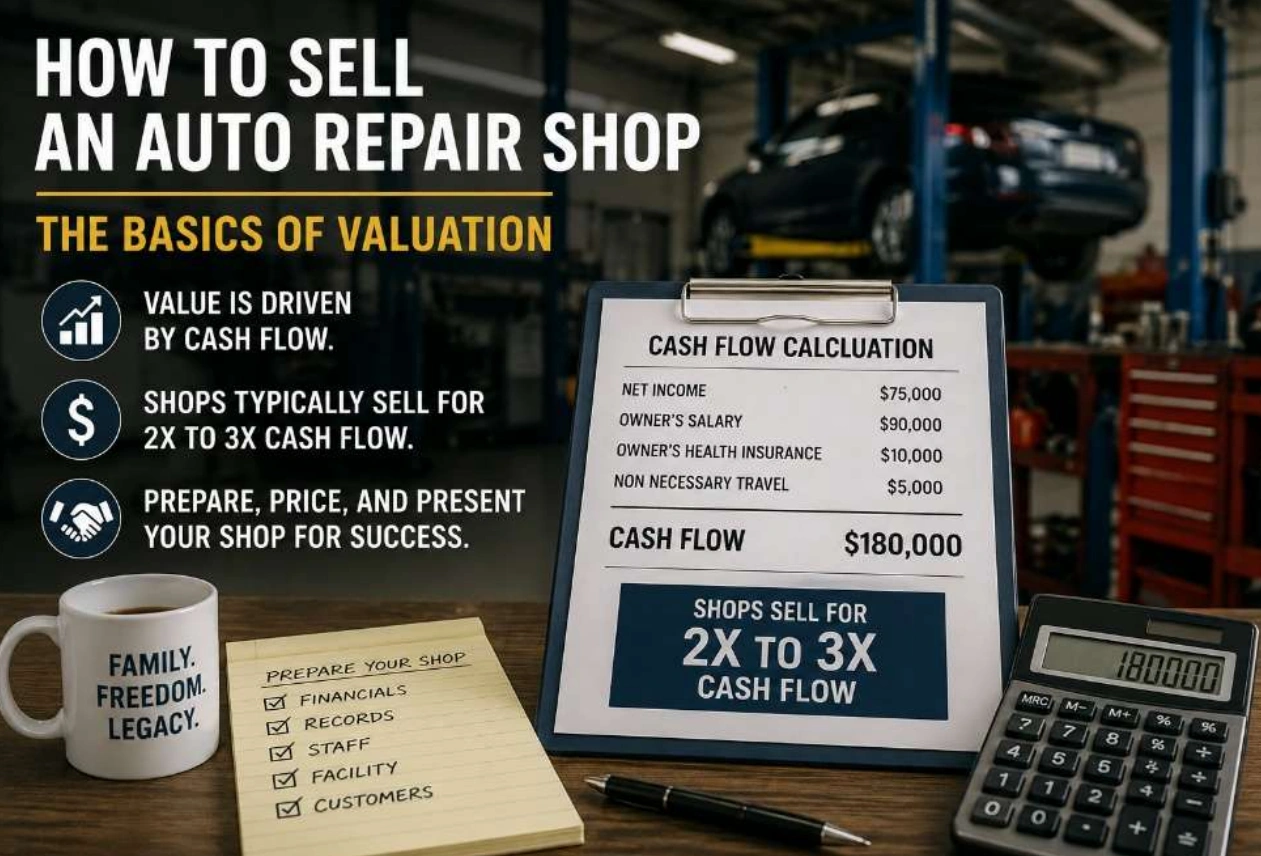
You start with Net Ordinary Income from your P&L or tax return, then add back the expenses a new owner either won’t have or that really went to you — owner salary, depreciation, amortization and interest, plus legitimate discretionary items like owner’s health insurance. The word that matters is the one in the definition: provable. If you can’t document it, it doesn’t count, no matter how real the money was to you.
We work through the arithmetic step by step, with the addbacks that are easy to miss, in which addbacks count.
Applying the Multiple: What Auto Repair Shops Sell For
Once you have Seller’s Discretionary Earnings tied down, you multiply it by somewhere between 2 and 3 and you are pretty close to what a buyer will pay. That’s the short version of auto repair shop valuation. A shop with $300k in SDE will usually go to market at around $900k.
It’s a sliding scale, and it tracks the size of the number. If your SDE is around $100k, your multiple is in the low 2s. Around $200k, high 2s. At $250k to $300k, you’re close to 3. The more money the shop makes, the better the multiple it earns, and most of the shops we sell land between 2.5 and 3.0.
Keep in mind that 3x is usually an asking price. What the seller actually receives is often a little bit less. That’s normal. Negotiation happens, and a multiple applied to SDE is where the conversation starts, not where it ends.
What Moves the Multiple
Two shops with the same Seller’s Discretionary Earnings can sell for different prices.
What pushes a shop toward the top of the range
- SDE that has grown steadily over the last three years
- A strong crew of techs who plan to stay
- A good lease with plenty of time left on it
- Clean books that make the numbers easy to verify
What pulls it down
- The owner is the lead tech, the service writer, and the only one who knows the customers, so a buyer worries that SDE will drop when the owner leaves
- A short lease
- Declining revenue
- One fleet account that makes up a big chunk of the business
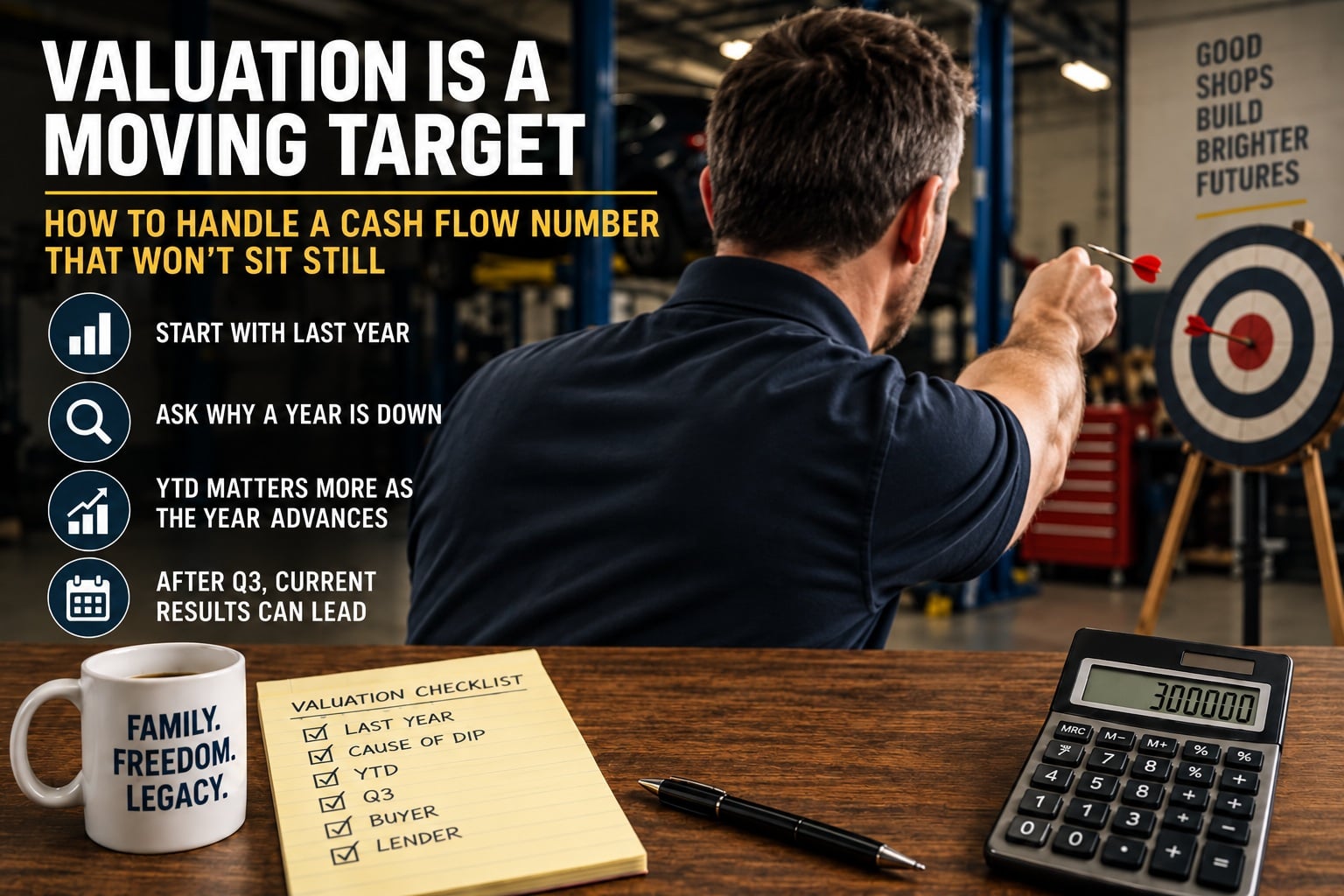
Which year’s numbers you use matters too, especially when the shop is having an unusual year. We cover that in which year’s numbers to use.
A Real Example: $360k SDE, $1.0M Sale Price
Here are the mechanics of a real deal. A shop had SDE of $360k. We asked $1.08m (3.0x) and settled at a final negotiated price of $1.0m (2.78x).
| Seller’s Discretionary Earnings | $360k |
| Sale price (2.78x SDE) | $1,000k |
| 10% down payment | $100k |
| Amount financed | $900k |
| Payment (10% interest over 10 years) | $11,894/month |
That works out to $30,000 a month in SDE against a payment of $11,894, leaving the buyer $18,106 a month. The business pays for itself with room to spare. That’s what a well-priced shop looks like.
Where Lenders Fit In: Financing and Debt Coverage
About 75% of the deals RPM closes involve third-party financing, so the lender acts as a reality check on any valuation. The lender’s main question is simple: does SDE cover the debt service? Lenders have coverage ratios that vary according to whether it’s an SBA deal or a conventional deal and what the lender’s appetite for risk is. This is an entire article in and of itself, but generally speaking there must be a certain amount of coverage available after debt service and taking the buyer’s personal budget into account.
Another thing worth mentioning is that lenders tend to recognize fewer addbacks than buyers do. Owner’s health insurance, for example, is often left out. So there are really two versions of SDE on most deals: the one the buyer accepts and the one the lender accepts. They’re both right. Just different. That gap is a big part of why a shop priced much above 3x SDE usually runs into trouble getting financed.
The Bottom Line
Auto repair shop valuation isn’t a mystery. Figure out your Seller’s Discretionary Earnings, make sure every addback is provable, apply a multiple that fits your shop’s strengths and weaknesses, and make sure the deal works for the buyer and the lender too.
There’s a lot more to this, but those are the basics. At RPM Shop Sales, we can help you make sense of it. We only sell auto repair shops, and we price every deal to work for the seller, while still working for the buyer and the lender. We’ve sold close to 100 shops. If you’re thinking about selling, now or in a few years, give us a call.
If you’re on the other side of the table, you can see our current auto repair shops for sale.
Frequently Asked Questions
What is my auto repair shop worth? Start with your seller’s discretionary earnings and multiply by 2.5 to 3.0. A shop earning $300,000 in SDE typically goes to market around $900,000, before adjusting for your lease, your crew and how the business performs without you.
What multiple do auto repair shops sell for? Most trade between 2.5x and 3.0x SDE, on a sliding scale that tracks the size of the earnings. 3x is normally the asking price rather than the closing price.
Is equipment included in the valuation? Yes, the lifts and scan tools transfer with the business. But buyers price the earnings, not the equipment. Equipment is a distant second.
Do lenders accept the same addbacks a buyer does? Usually not. Lenders recognize fewer of them — owner’s health insurance is often excluded — which is why a shop priced well above 3x SDE often cannot get financed.